
Maja Djordjevic is getting metaphysical. True to herself, her language is pixelized, her colours high-gloss, but her understanding of the world has grown sharper, her grasp of the essential characteristics of existence clearer, yet seemingly disillusioned. It seems that she is done describing human relationships or aptly depicting existential questionings - for now. It seems that the more she masters her craft, meticulously drawing each pixel by hand, the more you can clearly see that every drop of that enamel paint she so loves to use carries a message. Like bits and bytes skillfully arranged into the code of a useful, meaningful, relevant program, every stroke of her brush aims to bring us closer to the nature of reality, to what it means to exist, to what makes us what we are but also what motivates us to go on. It’s a paradox, you might think. How can anyone with such an acute observation of the world bring so much hope and positivity? I can tell you one thing: it’s this paradox that makes her work so touching, so achingly full of beauty. Until two years ago, Maja Djordjevic used a highly expressive pixelized rendering of a naked woman to depict rebellion, outrage, indecisiveness, conventions, expectations, desire, love and longing. She poured her heart out through this figure that she calls “my girl”, the “my” not only being a possessive, but denoting that this figure is an intrinsic part of her, of all the facets of her as a woman, of all the different persons that she is. At first glance, you might think her paintings are (and that she is) cute, that girl being so exuberant, bubbly and living against often pink backgrounds.
Don’t be fooled. While visually stunning, every painting tells a story extracted from Djordjevic’s own life: her upbringing in Serbia, her beliefs, her doubts and her (inter-)personal experiences. In Maja Djordjevic’s new body of work, her girl is nowhere to be found. She’s out of sight and it’s strangely palpable. Is she lurking behind some door, or at the other end of the corridor? Was she, like Dorothy, carried away by the tornado, or did she fall off a horse? Is she hanging from the third chandelier that no one can see? But hey, what you see is what you get. Maja Djordjevic’s new works, part of the Duet showcase at WSA, New York, are clearly signs of our times. Drawing inspiration of the Backrooms phenomenon that started as short internet-based horror stories happening in mazes of soulless office rooms, they refer to hidden, in-between digital spaces that are not meant to be seen. They also refer to hidden and restricted parts of software that only certain specialists can access. Virtual, dystopian, grandiose, absurd, the paintings are shiny, intricate and feel achingly real. But - here’s that paradox again - they are also full of magic and poetry and hope. Like the artist herself. Because no matter how dark the times, how harsh the reality, her hope is as immense as her incredibly contagious moral obligation to bring joy. And girl, does she deliver.
The works on show at The Dio Horia Booth/Armory Show and & WSA/Duet
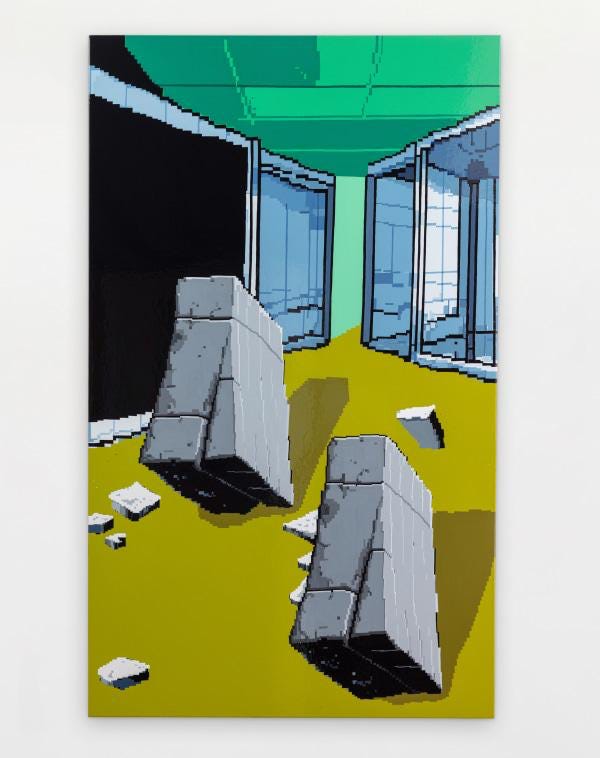
The Future Wasn’t Rendered I Wanna Watch End With You
Fragments from a not-so-distant past are collapsing, dropping off parts. Digitalisation, they said, will make everything better —high-performance parts, Expensive parts. Useful parts. Parts that you used to care about, you think. Not so much anymore. In a space that evokes infinity, yet feels like an office room, a strange nostalgia creeps in. Does it remind you of better times? Does it resuscitate an old hope? Or does it just make you feel that there’s no escape? No, wait. It’s a world of endless possibilities. You might be trapped in infinity, but your future is wide open. Maybe all you need to get there is a feeling of security.
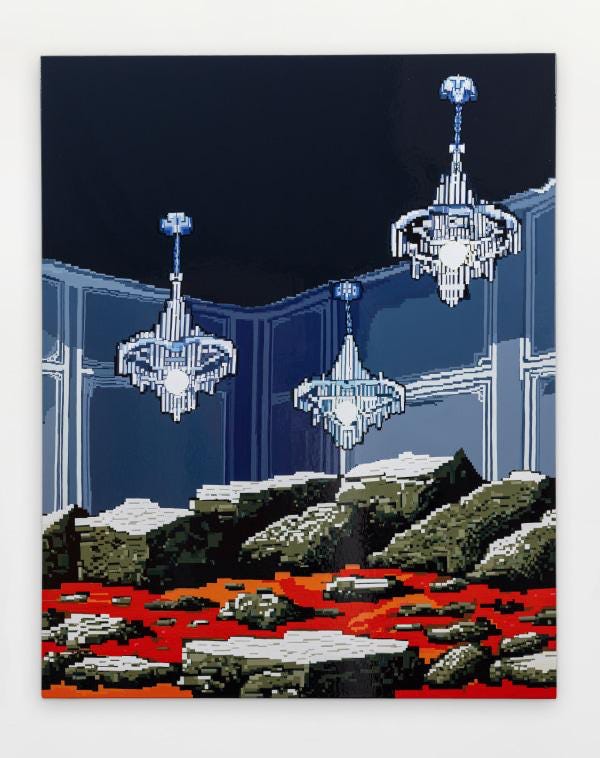
Rocky Road
It looks like the party is over. Nothing is left of the ballroom. No dancefloor, no tables, no music. The ceiling gave way to a pitch-dark sky. But wait, the chandeliers seem to still be there, weightlessly floating. Or did they just drop from high above? But how? Have I been playing Space Invaders for so long that I’m imagining all this? Or do I love all the fun and the glamour so much that I make joy happen even in the roughest landscapes? Do I transfer it to everything I possibly can?
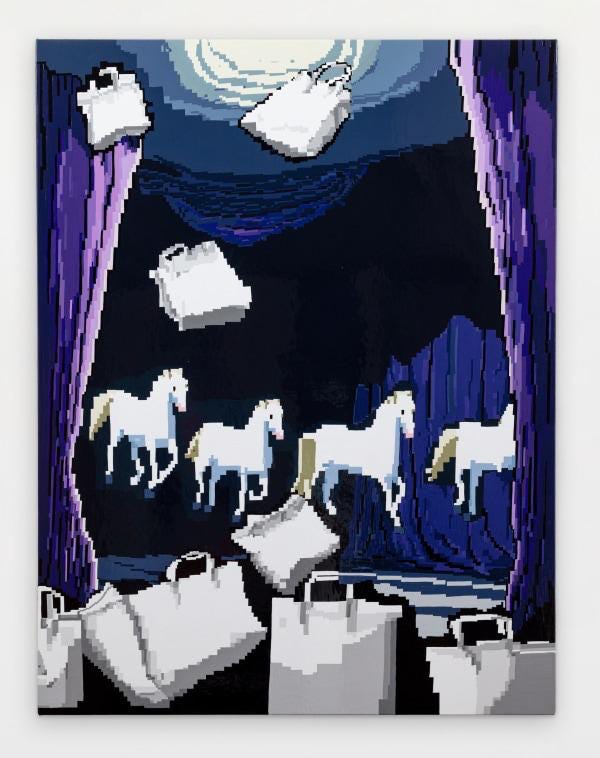
Memory of Us
With money, we can buy things. Buying things makes us happy. With money, we can do things. Doing things makes us free. So money brings us happiness. Why is everything fleeting then? Why does the vortex always appear? Ah, we must never forget how fragile we are.
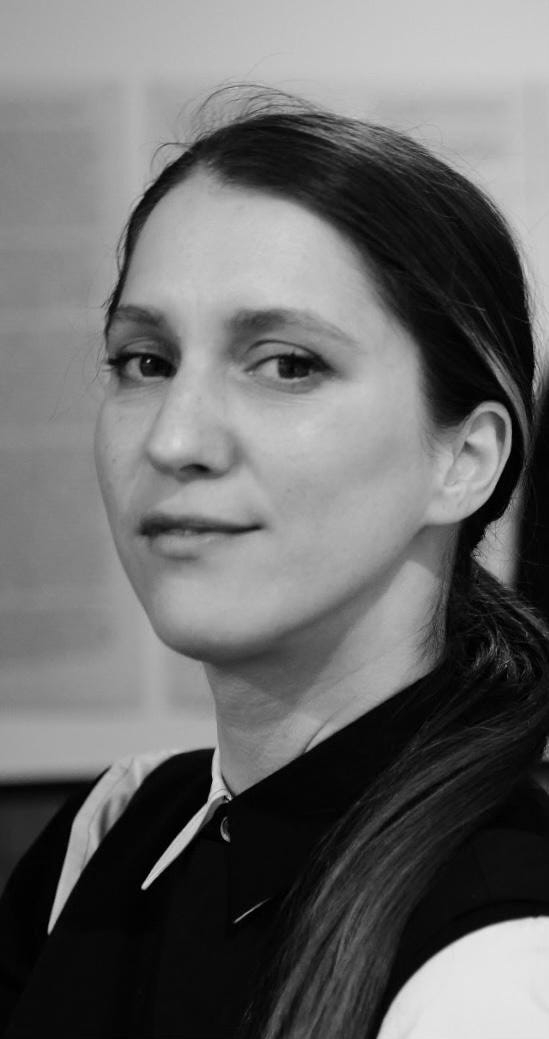
Maja Djodjervic (b. 1990) lives in works in London, United Kingdom.
Dio Horia Gallery – Lempesi 5-7 – Porinou 16 – Athens, Greece